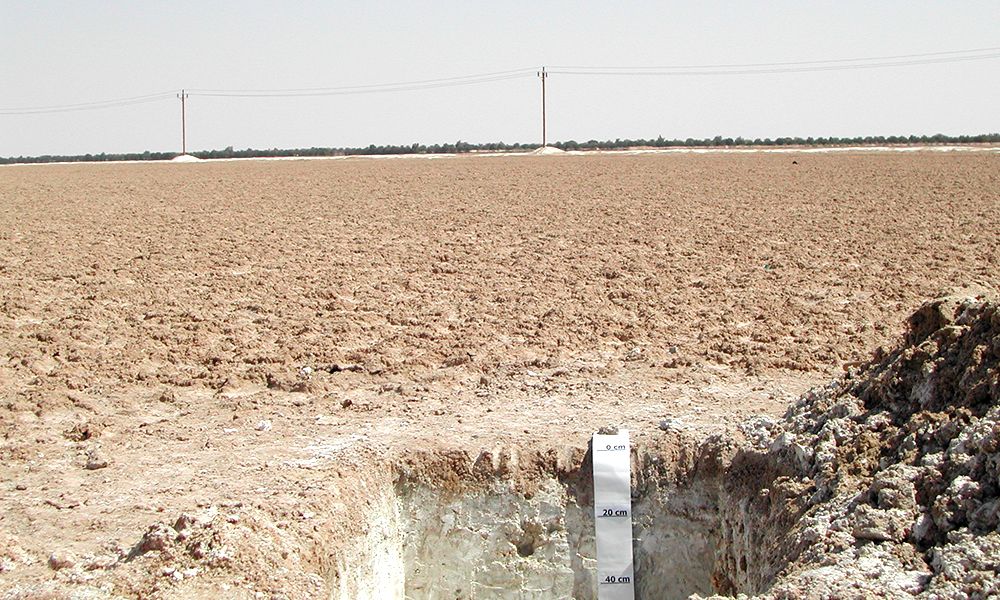
Soil Discovery in UAE
A world-first discovery in the UAE
A remarkable scientific milestone was achieved in the United Arab Emirates with the discovery of a soil type previously unknown to science. For the first time anywhere in the world, a completely new class of soil was described and formally recognized, a discovery that would go on to reshape international soil classification.
This soil, rich in anhydrite (CaSO₄), revealed a composition and structure so distinctive that it could not be placed within any existing soil category. Careful study confirmed that these were not simply variations of known soils, but represented an entirely new soil sub-surface diagnostic horizon, mineralogy class, and subgroup.
- A new diagnostic horizon was created: “Anhydritic”
- A new mineralogy class was added
- Two new soil subgroups were introduced: Anhydritic Aquisalids and Anhydritic Haplosalids
Where was it discovered?
The discovery was made in the Al Dhabaya coastal lands of Abu Dhabi, an area where the desert meets the sea. Here, saline and gypsiferous conditions created the perfect environment for the formation of this unusual soil.
Al Dhabaya’s landscape, shaped by centuries of wind, tides, and evaporation, offered the precise geological setting that allowed anhydrite to appear in the soil profile. This finding revealed that the UAE’s coastal environments (often perceived as barren or uniform) are in fact rich scientific frontiers, capable of producing discoveries that advance global understanding of the Earth’s resources.
Who Discovered It?
Dr. Shabbir A. Shahid, a senior soil scientist at the Dubai-based International Center for Biosaline Agriculture (ICBA) and his co-associates Dr Mahmoud Abdelfattah and Khaliq ur Rahman Arshad at the Environment Agency – Abu Dhabi (EAD) have first described this soil.
Why is it important?
This soil was so unique it reshaped the way soils are classified worldwide. In 2014, the US Keys to Soil Taxonomy officially added anhydrite soils thanks to the UAE’s contribution.
For the UAE, this was more than a scientific finding. It demonstrated the country’s role as a pioneer of global soil research, contributing knowledge that is now embedded in international standards used by scientists worldwide. The discovery of anhydrite soils reflects both the uniqueness of the UAE’s landscapes and the nation’s growing leadership in science, sustainability, and environmental stewardship.
By placing the UAE on the map of global soil science, this achievement has become part of the country’s scientific heritage; a reminder that even in the desert, the land continues to reveal secrets with the power to advance human understanding and inspire future generations.
What changed in soil science?
Following extensive evaluation, the proposal was accepted by the USDA Natural Resources Conservation Service (NRCS). In 2014, the Twelfth Edition of the US Keys to Soil Taxonomy introduced several major updates inspired by this discovery:
- A new sub-surface diagnostic horizon “Anhydritic” was added, with this addition globally the number of sub-surface diagnostic horizons increased to 20.
- A new soil mineralogy class (Anhydritic) was added, with this addition globally the number of soil mineralogy classes increased to 33.
- A new soil subgroup “Anhydritic Aquisalids” was added, with this addition the number of soil subgroups under the great group Aquisalids is increased to 4.
- A new soil subgroup “Anhydritic Haplosalids” was added, with this addition the number of soil subgroups under the great group Haplosalids is increased to 6.
In the foreword to the 2014 edition, David W. Smith, Director of the USDA-NRCS Soil Science Division, highlighted this as one of the most important advances in modern soil taxonomy, noting that the inclusion of anhydrite soils reflected a significant international collaboration led by scientists in the UAE.
This achievement carries broad implications. Scientifically, it enhances understanding of soils in saline and gypsiferous conditions, deepening knowledge of arid land processes. Agriculturally, it provides valuable insights for land management and crop production in challenging desert environments. At the global level, it demonstrates how discoveries made in the UAE can directly shape international standards and advance humanity’s collective understanding of the Earth’s soils.