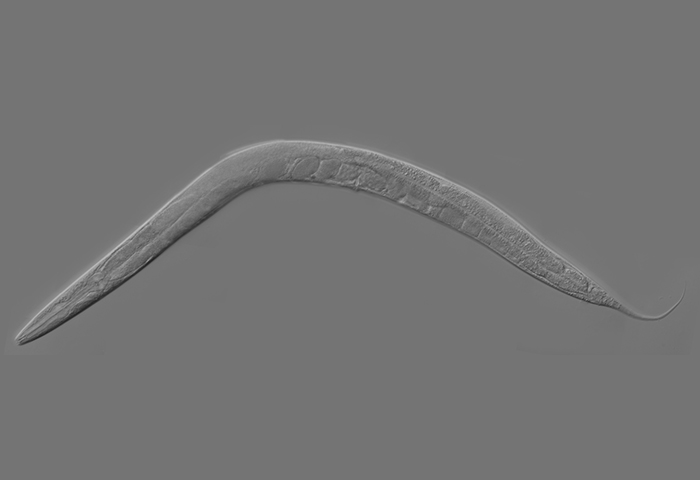
Caenorhabditis elegans. Image credit: Kbradnam, 2006 (https://eol.org/pages/403869/media)
Nematodes are by far the most abundant animals on Earth and represent a major component of the soil community. A recent estimate postulated that 4.4 × 10²⁰ nematodes inhabit surface soils across the world, with higher abundances in sub-Arctic regions (38% of the total) than in temperate (24%) or tropical (21%) regions. This abundance corresponds to a total biomass of approximately 0.3 gigatonnes! Nematodes are microscopic and live in water-filled spaces in the soil. This occurs more frequently in the upper layers of the soil as that is where many of the resources that are used by these animals are most abundant. Nematodes do not decompose organic matter, but, rather, they have a parasitic and free-living lifestyle; in other words, nematodes feed on living material. Nematodes play important roles in the soil as bacterial population regulators, as nitrogen mineralizers and they also influence the composition of soil communities.
Interesting fact: Caenorhabditis elegans is a soil nematode that went on to become one of the most important and widely used model species for genetics and cell biology research. Amongst many other contributions, it was thanks to C. elegans that the scientific community learned about the molecular pathways involved in programmed cell death.
Diversity in soil: 10-100 per m2
Abundance in soil: 2-90 x 105 per m2
Classification: Microfauna